Skip to content

SSC General Math - 9th Phase (Trigonometric Ratios) Suggestions and Answer

By SH SOHEL. . 6 minute read.

এসএসসি সাধারণ গণিত – ৯ম অধ্যায় (ত্রিকোণমিতিক অনুপাত) সাজেশনের সৃজনশীল প্রশ্নগুলোর ক, খ, গ অংশের পূর্ণ সমাধান নিচে দেওয়া হলো। (প্রশ্নের নম্বর সাজেশন পিডিএফ অনুযায়ী রাখা হয়েছে।)

প্রশ্ন ১

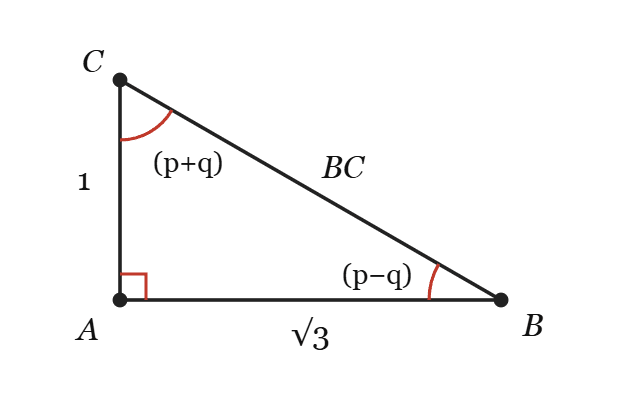
চিত্রে △ABC\triangle ABC এর সমকোণ AA বিন্দুতে, AB=3AB = \sqrt{3}, AC=1AC = 1, ∠B=(p−q)\angle B = (p-q) এবং ∠C=(p+q)\angle C = (p+q)।

প্রশ্ন ১ এর চিত্র

ক) উপরের চিত্র থেকে BC নির্ণয় কর।

সমাধান: সমকোণী △ABC\triangle ABC এ পিথাগোরাসের উপপাদ্য অনুযায়ী,

BC2=AB2+AC2BC^{2} = AB^{2} + AC^{2}

=(3)2+12=3+1=4= (\sqrt{3})^{2} + 1^{2} = 3 + 1 = 4

∴BC=2\therefore BC = 2

খ) tanB + tanC এর মান নির্ণয় কর।

সমাধান: tan⁡B=ACAB=13\tan B = \dfrac{AC}{AB} = \dfrac{1}{\sqrt{3}} এবং tan⁡C=ABAC=31=3\tan C = \dfrac{AB}{AC} = \dfrac{\sqrt{3}}{1} = \sqrt{3}

tan⁡B+tan⁡C=13+3\tan B + \tan C = \dfrac{1}{\sqrt{3}} + \sqrt{3}

=1+33=43=433= \dfrac{1 + 3}{\sqrt{3}} = \dfrac{4}{\sqrt{3}} = \dfrac{4\sqrt{3}}{3}

গ) p ও q এর মান কত?

সমাধান: tan⁡B=13=tan⁡30∘⇒∠B=30∘\tan B = \dfrac{1}{\sqrt{3}} = \tan 30^\circ \Rightarrow \angle B = 30^\circ

tan⁡C=3=tan⁡60∘⇒∠C=60∘\tan C = \sqrt{3} = \tan 60^\circ \Rightarrow \angle C = 60^\circ

সুতরাং, p−q=30∘p - q = 30^\circ ………(i)

p+q=60∘p + q = 60^\circ ………(ii)

(i) ও (ii) যোগ করে পাই, 2p=90∘⇒p=45∘2p = 90^\circ \Rightarrow p = 45^\circ

(ii) থেকে (i) বিয়োগ করে পাই, 2q=30∘⇒q=15∘2q = 30^\circ \Rightarrow q = 15^\circ

নির্ণেয় মান p=45∘p = 45^\circ, q=15∘q = 15^\circ।

প্রশ্ন ৩

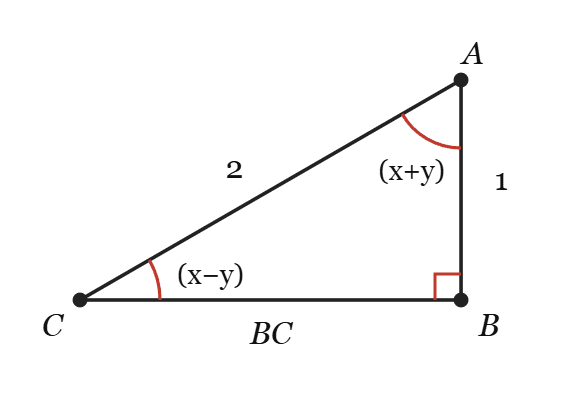
চিত্রে △ABC\triangle ABC এর সমকোণ BB বিন্দুতে, AB=1AB = 1, অতিভুজ AC=2AC = 2, ∠A=(x+y)\angle A = (x+y) এবং ∠C=(x−y)\angle C = (x-y)।

প্রশ্ন ৩ এর চিত্র

ক) BC = ?

সমাধান: BC2=AC2−AB2BC^{2} = AC^{2} - AB^{2}

=22−12=4−1=3= 2^{2} - 1^{2} = 4 - 1 = 3

∴BC=3\therefore BC = \sqrt{3}

খ) SinA + SinC = ?

সমাধান: sin⁡A=BCAC=32\sin A = \dfrac{BC}{AC} = \dfrac{\sqrt{3}}{2} এবং sin⁡C=ABAC=12\sin C = \dfrac{AB}{AC} = \dfrac{1}{2}

sin⁡A+sin⁡C=32+12=3+12\sin A + \sin C = \dfrac{\sqrt{3}}{2} + \dfrac{1}{2} = \dfrac{\sqrt{3}+1}{2}

গ) দেখাও যে, x/y = 3।

সমাধান: sin⁡C=12=sin⁡30∘⇒∠C=30∘\sin C = \dfrac{1}{2} = \sin 30^\circ \Rightarrow \angle C = 30^\circ

sin⁡A=32=sin⁡60∘⇒∠A=60∘\sin A = \dfrac{\sqrt{3}}{2} = \sin 60^\circ \Rightarrow \angle A = 60^\circ

সুতরাং, x+y=60∘x + y = 60^\circ ………(i)

x−y=30∘x - y = 30^\circ ………(ii)

(i) ও (ii) যোগ করে, 2x=90∘⇒x=45∘2x = 90^\circ \Rightarrow x = 45^\circ

(i) থেকে (ii) বিয়োগ করে, 2y=30∘⇒y=15∘2y = 30^\circ \Rightarrow y = 15^\circ

∴xy=45∘15∘=3\therefore \dfrac{x}{y} = \dfrac{45^\circ}{15^\circ} = 3 (দেখানো হলো)

প্রশ্ন ৪

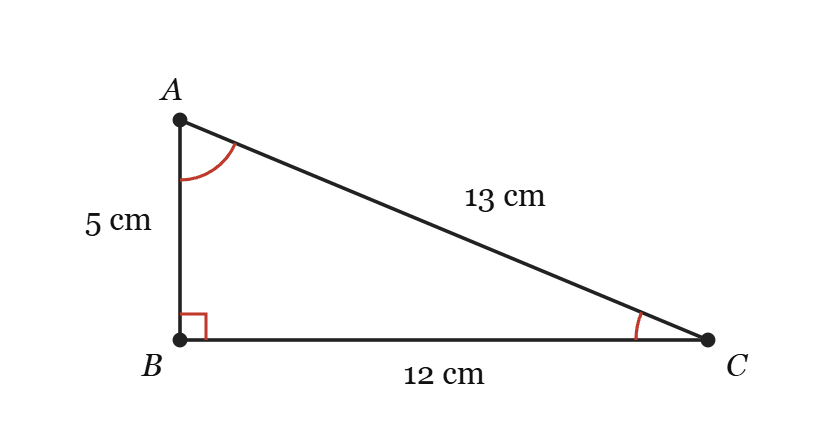
△ABC\triangle ABC এর ∠B=90∘\angle B = 90^\circ, AB=5AB = 5 সে.মি. এবং BC=12BC = 12 সে.মি.।

প্রশ্ন ৪ এর চিত্র

ক) AC এর মান নির্ণয় কর।

সমাধান: AC2=AB2+BC2AC^{2} = AB^{2} + BC^{2}

=52+122=25+144=169= 5^{2} + 12^{2} = 25 + 144 = 169

∴AC=13\therefore AC = 13 সে.মি.

খ) SinC + CosC এর মান নির্ণয় কর।

সমাধান: sin⁡C=ABAC=513\sin C = \dfrac{AB}{AC} = \dfrac{5}{13} এবং cos⁡C=BCAC=1213\cos C = \dfrac{BC}{AC} = \dfrac{12}{13}

sin⁡C+cos⁡C=513+1213=1713\sin C + \cos C = \dfrac{5}{13} + \dfrac{12}{13} = \dfrac{17}{13}

গ) দেখাও যে, Sec²A + Cosec²A = Sec²A·Cosec²A।

সমাধান: বামপক্ষ =sec⁡2A+csc⁡2A= \sec^{2}A + \csc^{2}A

=1cos⁡2A+1sin⁡2A= \dfrac{1}{\cos^{2}A} + \dfrac{1}{\sin^{2}A}

=sin⁡2A+cos⁡2Asin⁡2Acos⁡2A= \dfrac{\sin^{2}A + \cos^{2}A}{\sin^{2}A\cos^{2}A}

=1sin⁡2Acos⁡2A= \dfrac{1}{\sin^{2}A\cos^{2}A} [∵sin⁡2A+cos⁡2A=1\because \sin^{2}A + \cos^{2}A = 1]

=1cos⁡2A⋅1sin⁡2A= \dfrac{1}{\cos^{2}A} \cdot \dfrac{1}{\sin^{2}A}

=sec⁡2A⋅csc⁡2A= \sec^{2}A \cdot \csc^{2}A = ডানপক্ষ (দেখানো হলো)

প্রশ্ন ৬

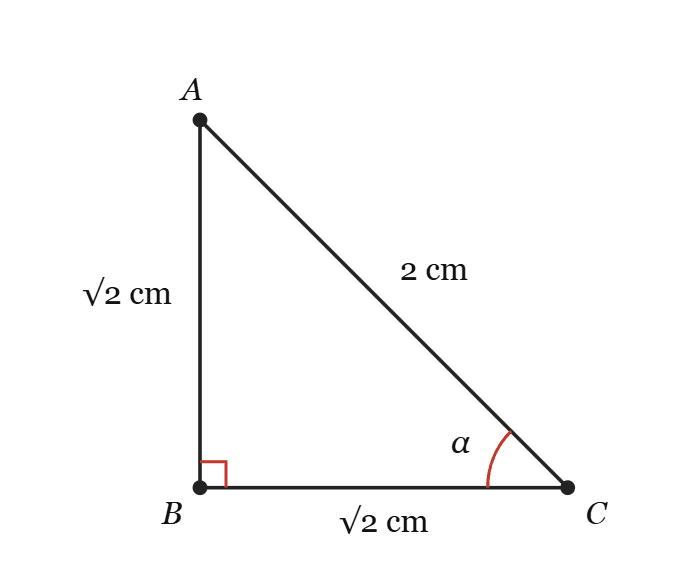
△ABC\triangle ABC এর ∠B=90∘\angle B = 90^\circ, AB=2AB = \sqrt{2} সে.মি., অতিভুজ AC=2AC = 2 সে.মি.।

প্রশ্ন ৬ এর চিত্র

ক) তথ্যানুযায়ী চিত্র অংকন কর।

সমাধান: একটি সমকোণী ত্রিভুজ ABCABC আঁকি যার সমকোণ BB বিন্দুতে, AB=2AB = \sqrt{2} সে.মি. (প্রায় 1.41 সে.মি.) এবং অতিভুজ AC=2AC = 2 সে.মি.। অপর বাহু BC2=AC2−AB2=4−2=2BC^{2} = AC^{2} - AB^{2} = 4 - 2 = 2 বলে BC=2BC = \sqrt{2} সে.মি.।

খ) ∠C = α হলে Secα − tanα এর মান নির্ণয় কর।

সমাধান: sin⁡α=ABAC=22=12=sin⁡45∘⇒α=45∘\sin\alpha = \dfrac{AB}{AC} = \dfrac{\sqrt{2}}{2} = \dfrac{1}{\sqrt{2}} = \sin 45^\circ \Rightarrow \alpha = 45^\circ

sec⁡α−tan⁡α=sec⁡45∘−tan⁡45∘\sec\alpha - \tan\alpha = \sec 45^\circ - \tan 45^\circ

=2−1= \sqrt{2} - 1

গ) দেখাও যে, Cosec²α − Cot²α = 2।

সমাধান: α=45∘\alpha = 45^\circ হলে, csc⁡245∘=(2)2=2\csc^{2}45^\circ = (\sqrt{2})^{2} = 2

cot⁡245∘=12=1\cot^{2}45^\circ = 1^{2} = 1

∴csc⁡2α=2\therefore \csc^{2}\alpha = 2 (প্রশ্নে উল্লেখিত মান) এবং csc⁡2α−cot⁡2α=2−1=1\csc^{2}\alpha - \cot^{2}\alpha = 2 - 1 = 1

নোট: সূত্র csc⁡2α−cot⁡2α=1\csc^{2}\alpha - \cot^{2}\alpha = 1 সকল α\alpha এর জন্য সত্য, তাই এই ত্রিভুজে csc⁡2α−cot⁡2α\csc^{2}\alpha - \cot^{2}\alpha এর মান 11। পিডিএফ-এ ছাপা 22 হলো csc⁡2α\csc^{2}\alpha এর মান (অর্থাৎ ছাপায় "−" অংশ বাদ পড়েছে); এখানে csc⁡2α=2\csc^{2}\alpha = 2 দেখানো হলো।

প্রশ্ন ৭

3tan⁡(A−B)=1\sqrt{3}\tan(A-B) = 1 এবং 3tan⁡(A+B)=3\sqrt{3}\tan(A+B) = 3 দুটি ত্রিকোণমিতিক সমীকরণ।

ক) A − B এর মান কত?

সমাধান: 3tan⁡(A−B)=1\sqrt{3}\tan(A-B) = 1

⇒tan⁡(A−B)=13=tan⁡30∘\Rightarrow \tan(A-B) = \dfrac{1}{\sqrt{3}} = \tan 30^\circ

∴A−B=30∘\therefore A - B = 30^\circ

খ) সমীকরণ থেকে A ও B এর মান নির্ণয় কর।

সমাধান: 3tan⁡(A+B)=3⇒tan⁡(A+B)=3=tan⁡60∘\sqrt{3}\tan(A+B) = 3 \Rightarrow \tan(A+B) = \sqrt{3} = \tan 60^\circ

∴A+B=60∘\therefore A + B = 60^\circ ………(i)

A−B=30∘A - B = 30^\circ ………(ii)

(i) ও (ii) যোগ করে, 2A=90∘⇒A=45∘2A = 90^\circ \Rightarrow A = 45^\circ

(i) থেকে (ii) বিয়োগ করে, 2B=30∘⇒B=15∘2B = 30^\circ \Rightarrow B = 15^\circ

গ) 'খ' থেকে প্রাপ্ত A ও B মানের জন্য সমীকরণের সত্যতা যাচাই কর।

সমাধান: A=45∘A = 45^\circ, B=15∘B = 15^\circ হলে,

১ম সমীকরণ: 3tan⁡(45∘−15∘)=3tan⁡30∘=3×13=1\sqrt{3}\tan(45^\circ - 15^\circ) = \sqrt{3}\tan 30^\circ = \sqrt{3} \times \dfrac{1}{\sqrt{3}} = 1 ✓

২য় সমীকরণ: 3tan⁡(45∘+15∘)=3tan⁡60∘=3×3=3\sqrt{3}\tan(45^\circ + 15^\circ) = \sqrt{3}\tan 60^\circ = \sqrt{3} \times \sqrt{3} = 3 ✓

সুতরাং A=45∘A = 45^\circ ও B=15∘B = 15^\circ মান দুটি সমীকরণকে সিদ্ধ করে।

প্রশ্ন ১১

cot⁡A=ba\cot A = \dfrac{b}{a}

ক) cotA + tanA = কত?

সমাধান: tan⁡A=1cot⁡A=ab\tan A = \dfrac{1}{\cot A} = \dfrac{a}{b}

cot⁡A+tan⁡A=ba+ab\cot A + \tan A = \dfrac{b}{a} + \dfrac{a}{b}

=b2+a2ab=a2+b2ab= \dfrac{b^{2} + a^{2}}{ab} = \dfrac{a^{2}+b^{2}}{ab}

খ) প্রমাণ কর যে, sinA = ± a/√(a² + b²)।

সমাধান: আমরা জানি, csc⁡2A=1+cot⁡2A\csc^{2}A = 1 + \cot^{2}A

=1+b2a2=a2+b2a2= 1 + \dfrac{b^{2}}{a^{2}} = \dfrac{a^{2}+b^{2}}{a^{2}}

⇒sin⁡2A=a2a2+b2\Rightarrow \sin^{2}A = \dfrac{a^{2}}{a^{2}+b^{2}}

∴sin⁡A=±aa2+b2\therefore \sin A = \pm\dfrac{a}{\sqrt{a^{2}+b^{2}}} (প্রমাণিত)

গ) (a sinA − b cosA)/(a sinA + b cosA) এর মান নির্ণয় কর।
সমাধান: লব ও হরকে sin⁡A\sin A দ্বারা ভাগ করে পাই,

asin⁡A−bcos⁡Aasin⁡A+bcos⁡A=a−bcot⁡Aa+bcot⁡A\dfrac{a\sin A - b\cos A}{a\sin A + b\cos A} = \dfrac{a - b\cot A}{a + b\cot A}

=a−b⋅baa+b⋅ba= \dfrac{a - b \cdot \dfrac{b}{a}}{a + b \cdot \dfrac{b}{a}}

=a2−b2aa2+b2a= \dfrac{\dfrac{a^{2}-b^{2}}{a}}{\dfrac{a^{2}+b^{2}}{a}}

=a2−b2a2+b2= \dfrac{a^{2}-b^{2}}{a^{2}+b^{2}}

প্রশ্ন ১২

tan⁡θ+sin⁡θ=a\tan\theta + \sin\theta = a, tan⁡θ−sin⁡θ=b\tan\theta - \sin\theta = b এবং sec⁡θ+csc⁡θ=2sec⁡θ\sec\theta + \csc\theta = \sqrt{2}\sec\theta।

ক) a² + b² এর মান নির্ণয় কর।

সমাধান: a2+b2=(tan⁡θ+sin⁡θ)2+(tan⁡θ−sin⁡θ)2a^{2} + b^{2} = (\tan\theta + \sin\theta)^{2} + (\tan\theta - \sin\theta)^{2}

=2(tan⁡2θ+sin⁡2θ)= 2(\tan^{2}\theta + \sin^{2}\theta)

খ) দেখাও যে, a² − b² = 4√(ab)।

সমাধান: a2−b2=(tan⁡θ+sin⁡θ)2−(tan⁡θ−sin⁡θ)2a^{2} - b^{2} = (\tan\theta + \sin\theta)^{2} - (\tan\theta - \sin\theta)^{2}

=4tan⁡θsin⁡θ= 4\tan\theta\sin\theta ………(i)

ab=(tan⁡θ+sin⁡θ)(tan⁡θ−sin⁡θ)=tan⁡2θ−sin⁡2θab = (\tan\theta + \sin\theta)(\tan\theta - \sin\theta) = \tan^{2}\theta - \sin^{2}\theta

=sin⁡2θcos⁡2θ−sin⁡2θ= \dfrac{\sin^{2}\theta}{\cos^{2}\theta} - \sin^{2}\theta

=sin⁡2θ(1−cos⁡2θcos⁡2θ)= \sin^{2}\theta\left(\dfrac{1 - \cos^{2}\theta}{\cos^{2}\theta}\right)

=sin⁡2θ⋅tan⁡2θ= \sin^{2}\theta \cdot \tan^{2}\theta

∴ab=sin⁡θtan⁡θ\therefore \sqrt{ab} = \sin\theta\tan\theta (ধনাত্মক মান ধরে)

(i) থেকে, a2−b2=4aba^{2} - b^{2} = 4\sqrt{ab} (দেখানো হলো)

গ) প্রমাণ কর যে, secθ − cosecθ = √2 cosecθ।

সমাধান: দেওয়া আছে, sec⁡θ+csc⁡θ=2sec⁡θ\sec\theta + \csc\theta = \sqrt{2}\sec\theta

⇒csc⁡θ=2sec⁡θ−sec⁡θ=(2−1)sec⁡θ\Rightarrow \csc\theta = \sqrt{2}\sec\theta - \sec\theta = (\sqrt{2}-1)\sec\theta ………(i)

এখন, sec⁡θ−csc⁡θ=sec⁡θ−(2−1)sec⁡θ\sec\theta - \csc\theta = \sec\theta - (\sqrt{2}-1)\sec\theta

=(2−2)sec⁡θ= (2 - \sqrt{2})\sec\theta

=2(2−1)sec⁡θ= \sqrt{2}(\sqrt{2}-1)\sec\theta

=2csc⁡θ= \sqrt{2}\csc\theta [(i) নং থেকে]

∴sec⁡θ−csc⁡θ=2csc⁡θ\therefore \sec\theta - \csc\theta = \sqrt{2}\csc\theta (প্রমাণিত)

Comments (0)

Be respectful. Comments appear after an admin reviews them.

Sign in or create an account to post.

No comments yet. Be the first.